Budgets and bank accounts
In short
Money comes and goes by mail: invoices, receipts, payment notices, payouts, tax notices. Budgets tells you where your money stands, in sentences, and keeps three things apart:
- bank accounts, where the money is: a current account, PayPal, Stripe;
- reserves, where it is set aside: savings accounts;
- budgets, what it is for: your duties (rent, energy, food), your leisure, your work, a project.
Sioul reads your bank's export files and the mail about payments, holds them against the payments you expect, and says calmly when one did not leave, or when an account may not hold the next one, early enough to move money. It never connects to your bank, never shows red, and never shows offers.
Protected by default
- Sioul never logs in to your bank and holds no bank password: you download your bank's file, and Sioul reads it on your device.
- Your budgets, your bank's movements and your contracts are plain files in your own notes folder. There is no server of Sioul's.
- Between your devices, they travel by your folder's own sync, or sealed through Sioul's sharing once you switch Projects and money on: the folder and its server can read nothing of them (Sharing).
- Mail is read as a payment only once it passed Sioul's checks: forged mail, spam, a sender borrowing a bank's or a shop's name, and blocked senders are never read as payments. A payment from someone new and not verified says to check it first: a fake "your payment" is a common trick.
- An AI agent, only if you connect one, reads a summary of your budgets, never moves money, and sees account numbers masked.
- No offers, no comparisons, no "better deals", no advertising, no analytics.
Budgets
New budget:
- Name.
- Counted by: the month or the year.
- Balance to reach by the end of each period: 0 to break even; more is saving.
- For: work, your admin, leisure. It decides the hours the budget is in view (Hours). None ticked: your admin.
What a budget did not spend carries over, as an envelope keeps what is left: money set aside in October for a bill due in December is still there in December.
At a glance
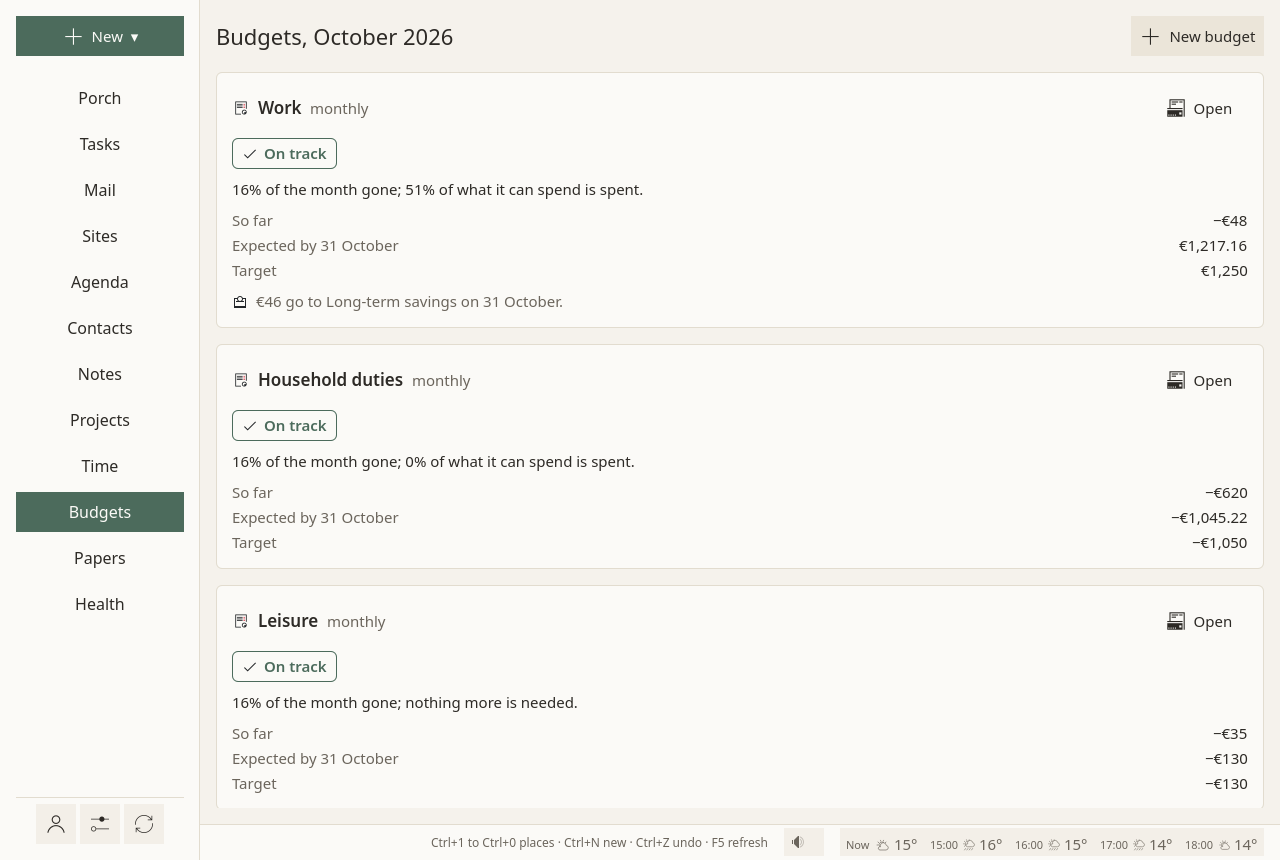
Each budget is a card: its name and period, the verdict on its own line (On track, Ahead of its pace, Behind its pace, with by how much), then one figure per line: what came so far, what is expected by the end of the period, the balance to reach, what was carried in, and what is set aside for later.
The verdict does not assume that money flows evenly. What is known in advance (a rent, a planned bill) counts in full. The rest is weighed against the part of the period gone: "40% of the month gone; 35% of what it still needs has come in." After three periods, the expected end comes with a range, from a bad month to a good one.
A budget, open
A budget opens on its movements, newest first, and its balance by Days, Weeks, Months or Years, the planned ones dotted.
Add a movement: Once, or Recurring (every month or every year, on a day). An amount is negative for money out (-650) and positive for money in (1200). For what is spent little by little, such as food, see Daily spending.
A right click on a line: Change this line…, Delete this line (asked once). If the line changed in the file meanwhile (on another device, or by hand), nothing is changed, and Sioul says so: look at it again.
Take this budget out keeps its lines in the file, as they were written; they no longer count.
Reserves
New reserve: its Name, its Balance on a day, the amount it should never go below, and the days money asked from it takes to arrive (0 for a savings account you can move from at once, longer for others).
Each reserve shows its balance today, what moved this month, its balance at the end of the year, and how long it lasts at this pace, above its floor.
Which reserve covers which budget is written in the budget file: at the end of each period, a budget's shortfall is taken from its reserve.
Mail about money
Below the budgets, the mail about money, newest first. Sioul reads, in English and French, what a message says: a payment received or made, an order, a bill, a refund; the amount; who paid, or was paid.
Each line says where it stands: counted, the same payment as another message (an order and its payment count once), or waiting for you, with Add and Not a payment. A line from someone new and not verified says to check it is genuine first. Forged mail, spam and blocked senders are never read as payments. An amount in another currency is marked "to convert": Sioul does not convert it yet.
Rules in the budget file can send a sender's or a word's payments to a budget by themselves.
Bank accounts
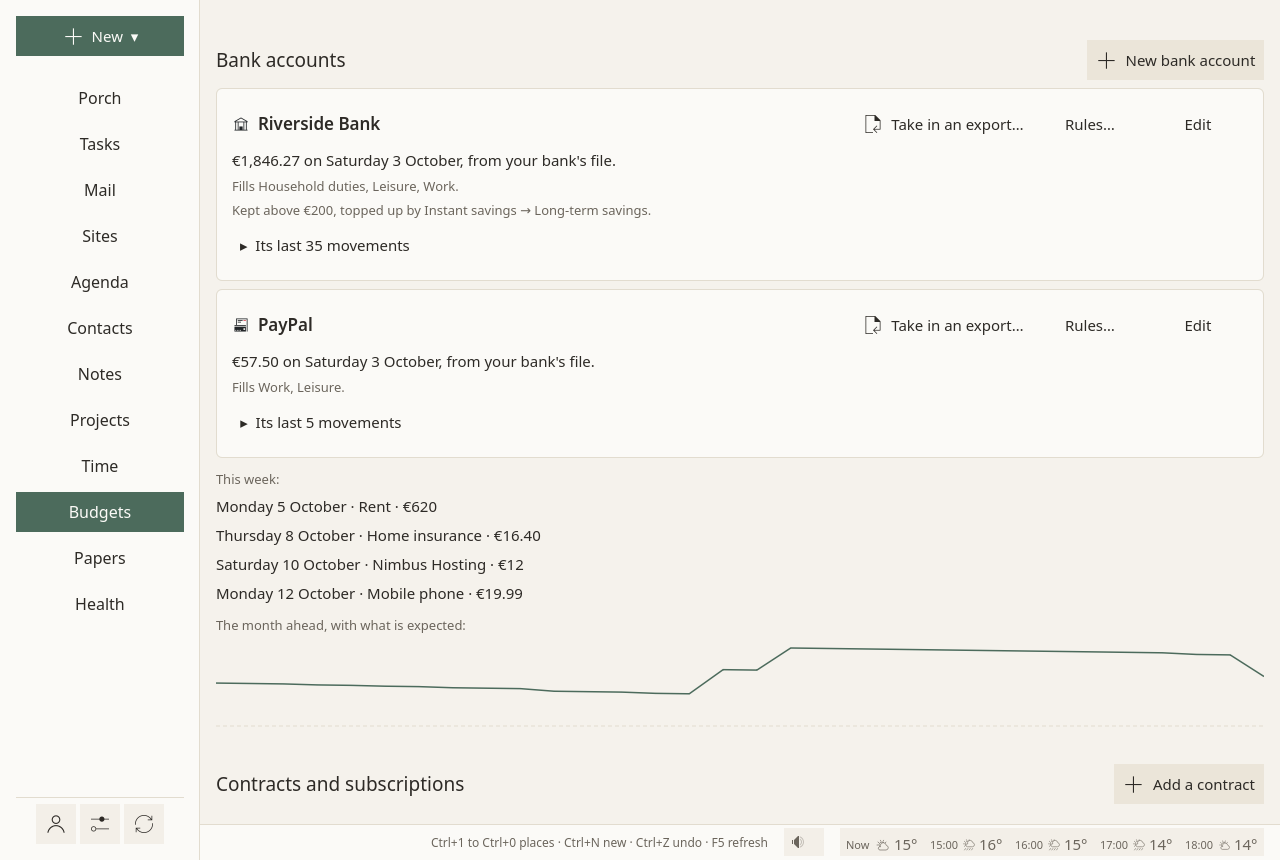
New bank account: its Name, its Kind (a bank, PayPal, Stripe, something else), the budgets it Fills, the amount it is Kept above, and the reserves it is Topped up by, in your order.
Take in an export…, on its card: the file your bank gives (OFX or QFX, CAMT.053, or its CSV), PayPal's activity download, or Stripe's balance history. Reading the same file twice adds nothing. Nothing is fetched from the bank itself: you download the file, Sioul reads it. Each movement then goes to a budget by your hand, your rules, or the payment it stands for, and says why (Where each movement goes).
Topped up in time
Each account is carried forward a month. On the first day it would go below its floor, Sioul says what to move, from which reserve, and by when, counting the days that reserve takes: "Savings: ask for €590 by Thursday 15 October; it takes about ten days, and the rent leaves on 1 November." When asking today is already too late, it says so.
The bank watch
A debit that stops does not say so. Sioul holds your bank's movements against the payments you expect, and says, in sentences:
- what has not left: "Phone (€19.99) has not left the account. Expected around 12 September, not in your bank's movements.";
- what changed: "Electricity took €71.40 on 5 September, where €62 was expected.";
- what may not be held: "The account may not hold the rent on 1 November. €579.99 will be missing then.", with the reserve that covers it when one does.
This week: the payments of the next seven days, in one line, here and at the top of the Porch: "This week: Electricity €62 (Mon). The account holds them." The month ahead: the balance as a plain line, zero dashed.
Reminders, each once, when work starts: two working days before a planned payment (a bill, a tax), saying whether the account will hold it; a week after a payment that did not leave; five working days before a day the account would not hold a payment. They come from a computer only, while Sioul is open or, if you ask, with its window closed (Settings ▸ Reminders; not on Windows yet). A phone does not tell them.
Contracts and subscriptions
What you are bound to: rent, energy, phone and internet, insurances, health cover, subscriptions, hosting, the bank. Forgotten subscriptions are part of what people with ADHD call the "ADHD tax"; knowing what an insurance covers matters before a legal step.
Add a contract: with whom, your number with them, the recurring payment that pays it, since when, when it renews (each month, each year, or no renewal), the notice it needs, how to stop it (its cancel page, or where to write), and what it covers.
- Where it stands, in a sentence: "Renews on Tuesday 1 December; to stop it, the notice must leave by 2 October."
- The usual notice for its kind is proposed, with the rule it comes from (in France). Yours is what your contract says.
- A reminder, once, two weeks before the last day a notice can leave, for contracts that renew each year. Like the money reminders, it comes from a computer only.
- Stop it…: Open its cancel page, or Write the letter: a formal draft to its address, with your number, asking for a written confirmation. You read it, sign it and send it. It has ended keeps it, faded, as a record.
Recurring payments with no contract yet are listed below, each with Note it. A message can become one with Keep as a contract…, in its menu.
Sioul never shows offers, comparisons or "better deals": only facts about your contracts.
Where it is kept
In plain files at the root of your notes folder: sioul-budgets.toml (budgets, reserves, lines, rules, bank accounts), sioul-bank.toml (the bank's movements), sioul-contracts.toml. Readable, editable by hand, versioned with git if you like. They travel with your notes folder, or sealed through Sioul's sharing once you switch Projects and money on in it (Sharing); nothing is sent anywhere else.
In leisure, during a meal and while you sleep, only the budgets for leisure are in view. See Hours.
Going further
Where each movement goes
In this order:
- Your hand: Where it goes, on a movement's row, places it in a budget, or in none.
- The same payment as a line already counted, from mail or by hand: counted once.
- Money moved between your own accounts: in no budget, since the other side is read.
- The first of your rules that holds (Rules…, on the account's card): words in the label, money in or out, and where it goes: a budget, the recurring payment it stands for, a reserve, another account. A rule without words takes every movement its way.
- The recurring payment it stands for, by its name or its amount, near its day: the real amount replaces the planned one.
- The account's first budget.
Each movement says why it went where it did.
Daily spending
An estimate (food, cash), not a fixed amount, on a recurring line, says it is spent little by little: a card payment that stands for nothing else is taken from it, the estimate with the most left first, and only spending beyond it counts more. Real spending is taken from the estimate, never added on top.
Downloading your bank's file
Your bank's site can be kept in Sites: Sioul fills your login from Bitwarden, and your security key answers where your bank accepts one. The file you download there is then one Take in an export… away.
In the terminal
sioul budgets prints the budgets, the reserves and the payments mail proposes, as the page says them.
With an AI agent
If you connect an AI agent (Using an AI agent), it can read what this page says: the budgets, the reserves, the bank accounts' last balance and what the watch noticed. It cannot move money or change a line, and it sees account numbers masked.
Why it works this way
Arrears grow silently: a debit stops, nothing says so, and nobody looks when accounts go badly (Olafsson & Pagel 2017). A payment reminder that ignores the balance can push an account into overdraft (Medina 2021). So Sioul reads the bank's own movements, and says when the account will not hold a payment, before it happens.
Compared with other apps
As of October 2026, from each app's own documentation.
✓ documented; partly, with a note; ✗ not found in the app's own documentation (for Sioul: not built); ? not confirmed; — not applicable. Sioul's column was checked against its code.
For everyone
| Sioul | YNAB | Actual | Firefly III | GnuCash | Bankin' | |
|---|---|---|---|---|---|---|
| Budgets by what money is for; unspent money kept | ✓ | ✓ | ✓ | partly¹ | partly² | partly³ |
| Where each budget stands, at the period's pace, in words | ✓ | partly⁴ | ✗ | ✗ | partly⁵ | ✗ |
| Payments expected, matched with the bank's movements | ✓ | ✓ | ✓ | ✓ | ✓ | partly⁶ |
| Says when an expected payment did not leave, or took another amount | ✓ | ✗ | partly⁷ | partly⁸ | ✗ | ✗ |
| Says ahead that an account will not hold a payment, and what to move by when | ✓ | ✗ | ✗ | ✗ | ✗ | partly⁹ |
| Payments read from your mail, counted once | ✓ | ✗ | ✗ | ✗ | ✗ | ✗ |
| Contracts: renewal, notice deadline, a cancellation letter | ✓ | ✗ | ✗ | ✗ | ✗ | ✗ |
| Reads your bank's export files | ✓ | ✓¹⁰ | ✓ | ✓¹¹ | ✓ | ✗ |
| Connects to your bank by itself | ✗¹² | ✓ | ✓ | ✓¹¹ | partly¹³ | ✓ |
| Reports and charts | partly¹⁴ | ✓ | ✓ | ✓ | ✓ | partly¹⁵ |
| Investments, several currencies, double-entry books | ✗¹⁶ | partly¹⁷ | partly¹⁸ | ✓ | ✓ | partly¹⁹ |
- By the kind of budget: a fixed amount each period is gone at the next one; "add money … every month" makes it grow.
- A budget sets planned amounts per account and period against the actual ones, in reports.
- Budgets by category of spending; carrying over is not described.
- Progress bars in colours against a target; red when spending exceeds what is available.
- A budget report sets the planned against the actual.
- A forecast of the end-of-month balance.
- A schedule whose date has passed without its payment shows "missed" (from its source code); amounts matched "approximately" within 7.5 %.
- Subscriptions have a minimum and a maximum amount, and a box on the front page "will tell you how you're doing".
- A notification before an overdraft, and the end-of-month forecast.
- On the web and on an iPad, not on phones.
- Through the Data Importer, installed beside it.
- By choice: you download the file from your bank, and Sioul reads it on your device.
- German banks through HBCI/FinTS, and banks that speak OFX.
- Each budget's balance by days, weeks, months or years.
- Budget history, and this month against last month, in Bankin' Plus.
- An amount in another currency is marked, not converted.
- Investment accounts kept as tracking accounts; another currency in a separate budget.
- Reports include investment accounts.
- Savings and stock accounts, in Bankin' Plus.
For technical readers
| Sioul | YNAB | Actual | Firefly III | GnuCash | Bankin' | |
|---|---|---|---|---|---|---|
| Where your money's data lives | plain files in your notes folder | YNAB's servers | your device and your server | your server | a file on your computer | Bankin's servers, in Europe |
| Needs an account with the maker | no | yes | no | no | no | yes |
| Encrypted end to end between your devices | ✓¹ | ✗² | partly³ | — | — | ✗ |
| Export formats read | OFX, QFX, CAMT.053, CSV, PayPal, Stripe | CSV, OFX, QFX, QIF | CSV, QIF, OFX, QFX, CAMT | CSV, CAMT.053 | QIF, OFX, QFX, CSV, MT940, MT942, CAMT.052 and more | — |
| A file read twice adds nothing | ✓ | ✓ | ✓ | ✓ | ✓ | — |
| Bank connections through | none | Plaid, MX | Enable Banking, SimpleFIN, Pluggy.ai, Akahu; GoCardless⁴ | GoCardless, Enable Banking, SimpleFIN, FinTS and others | AqBanking (HBCI/FinTS), OFX | its own (Bridge, licensed by the ACPR) |
| Free software | ✓ GPL-3.0+ | ✗ | ✓ MIT | ✓ AGPL-3.0 | ✓ GPL | ✗ |
- XChaCha20-Poly1305, with a key made from your passphrase by Argon2id; once you switch Projects and money on.
- Encrypted at rest and in transit on YNAB's servers; end-to-end encryption is not mentioned.
- Optional; bank-sync tokens are not covered, and the copy on your device is not encrypted.
- Listed as "not accepting new accounts".
Others do more in places: YNAB, Actual, Firefly III and Bankin' connect to the bank by themselves, and GnuCash does for German banks; GnuCash and Firefly III keep double-entry books, investments and several currencies; the four budget apps make fuller reports, and their phone apps have more use behind them. What Sioul adds is the watch in sentences, the mail read as payments and counted once, and your contracts with their notice deadlines, all without a bank connection.
Sources
All read on 8 October 2026.
- YNAB, its help centre (glossary, progress bars, file import, direct import in Europe, scheduled transactions, overspending, and its index), its security page and its prices: https://support.ynab.com/en_us/ynab-glossary-a-guide-BJd80SORq, https://support.ynab.com/en_us/progress-bars-a-guide-SkDEhot09, https://support.ynab.com/en_us/file-based-import-a-guide-Bkj4Sszyo, https://support.ynab.com/en_us/direct-import-in-europe-Syae1z_A9, https://support.ynab.com/en_us/scheduled-transactions-a-guide-BygrAIFA9, https://support.ynab.com/en_us/overspending-in-ynab-a-guide-ryWoxEyi, https://support.ynab.com/llms.txt, https://ynab.com/security, https://www.ynab.com/pricing
- Actual Budget, its documentation on budgeting, importing, bank sync, rules, schedules, sync, installing and reports, and its repository (
schedules.tsfor "missed"): https://actualbudget.org/docs/budgeting/, https://actualbudget.org/docs/transactions/importing, https://actualbudget.org/docs/advanced/bank-sync, https://actualbudget.org/docs/budgeting/rules/, https://actualbudget.org/docs/schedules, https://actualbudget.org/docs/getting-started/sync, https://actualbudget.org/docs/install/, https://actualbudget.org/docs/reports/, https://github.com/actualbudget/actual - Firefly III, its documentation on budgets, subscriptions, file imports and data providers, and its repository: https://docs.firefly-iii.org/how-to/firefly-iii/finances/budgets/, https://docs.firefly-iii.org/explanation/financial-concepts/budgets/, https://docs.firefly-iii.org/explanation/financial-concepts/subscriptions/, https://docs.firefly-iii.org/how-to/data-importer/import/file/, https://docs.firefly-iii.org/tutorials/data-importer/data-providers/, https://github.com/firefly-iii/firefly-iii
- GnuCash, its features page, its manual on importing and on preferences, and its guide's chapter on budgets: https://www.gnucash.org/features.phtml, https://www.gnucash.org/docs/v5/C/gnucash-manual/trans-import.html, https://www.gnucash.org/docs/v5/C/gnucash-manual/set-prefs.html, https://code.gnucash.org/docs/C/gnucash-guide/chapter_budgets.html
- Bankin', its own description in Apple's App Store (its help centre could not be read), its Plus and Pro page and its home page: https://apps.apple.com/fr/app/bankin-la-meilleure-app-pour-g%C3%A9rer-mon-argent/id447040033, https://bankin.com/fr/pluspro.html, https://bankin.com
For technical readers
Files. sioul-budgets.toml (budgets, recurring payments, lines, reserves, covers, mail rules, bank accounts, their rules and your single choices), sioul-bank.toml (each account's movements by the bank's own id, its newest balance), sioul-contracts.toml: TOML at the root of your notes folder, written with their comments kept. Messages you said are not payments are listed in ~/.local/state/sioul/money.toml on Linux. Amounts are kept in whole cents, so sums never drift, and amounts written in every national style are read ("1 234,56 €", "€1,234.56", "(62.00)").
Exports. OFX 1.x (SGML) and 2.x (XML), by each movement's FITID; ISO 20022 camt.053, versions 001.02 to 001.08 (booked entries, the closing booked balance, names under Pty); a bank's CSV, its header found by its words, with ; or ,, decimal commas, debit and credit apart or not, and a balance written above the table; PayPal's activity (net of fees; pending, refused and memo rows left out, and rows in another currency than most of the file's); Stripe's balance history. A movement without an id gets one made from its day, amount and label: a file read twice adds nothing.
The pace. What is scheduled (recurring payments, planned lines) counts in full. For the rest, Sioul compares what has come in or left so far with the share of the period gone: ten days into thirty, a third of what the period still needs should have come in, or no more than a third of what it may spend should be spent. Within 5 % of what the period moves (and never closer than 10), the budget is on track: the same tolerance as sioul budgets on the command line. The range comes from the last twelve periods with movements: lowest to highest from three, 10th to 90th percentile from ten.
The watch. An expected payment is looked for from three days before its date to seven after, by a word of its name, or by its amount (within 1 %, three days around). "Took another amount" means more than 5 % and €2 apart. The balance is carried 31 days ahead, daily spending spread over its days. A top-up is rounded up to ten and asked as many days ahead as its reserve takes.
Mail. Only mail that passed the authentication checks is read for payments (Every message checked): never mail set aside (forged, spam, a borrowed name, a blocked sender), nor the review queue. Payments are read by rules, in French and English, from the subject and the start of the text; a share capital in a legal footer is never taken for an amount.
Sealed between devices. With Projects and money on, each change to the three files is sealed with XChaCha20-Poly1305 (a random 192-bit nonce each), bound to the device that wrote it, its place and its time, under a key made from your passphrase by Argon2id (64 MiB, three passes) and kept in each device's keyring (Sharing).
The AI agent. Its budgets tool reads through the same view as the window, writes nothing, and masks IBANs ("[IBAN …0189]").
Contracts. The usual notices proposed are France's: three months for a tenant (one in a furnished flat or a tight area); one month for insurances and health covers after their first year (loi Hamon); at most ten days for phone and internet after twelve months; none for energy (art. L224-13 of the consumer code). Online, a cancel button has been required since 1 June 2023 (loi 2022-1158).